Showing posts with label cameras. Show all posts

Friday, 2 March 2012

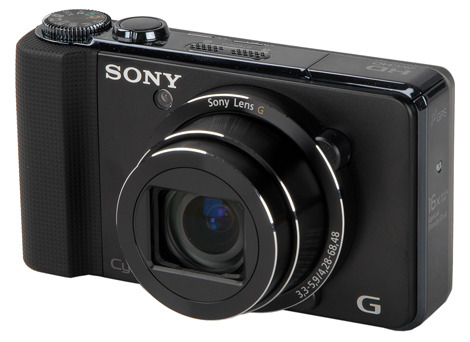
Sony Cyber-shot HX9V

Sony is out for blood with their HX9V, a relatively expensive, high performance travel zoom that aims to be nothing less than the best camera in the category. Optical zoom has been upgraded to 16x, and it’s likely Sony stuck with the same 16 megapixel sensor that powers their excellent HX100V, as well as this camera’s predecessor, the HX7V.
All of the HX9V’s resolution scores are equal or better than the models in our comparison group, this comes at a price though. Harsh haloing and edge enhancement sometimes make corners and geometry ugly and unappealing, even though test scores are high.
Some effort has been invested in physical handling of this camera’s body, the results are hit or miss. A raised and rubberized hand grip wraps around the right side of the front panel and half of the right panel. We like this, but the raised portion is too skinny to grip comfortably with an adult-sized hand.

Wednesday, 15 February 2012

Canon EOS 5D Mark II In-depth Review

Back in August 2005 Canon 'defined a new DSLR category' (their words) with the EOS 5D. Unlike any previous 'full frame' sensor camera, the 5D was the first with a compact body (i.e. not having an integral vertical grip) and has since then proved to be very popular, perhaps because if you wanted a full frame DSLR to use with your Canon lenses and you didn't want the chunky EOS-1D style body then the EOS 5D has been your only choice. Three years on and two competitors have turned up in the shape of the Nikon D700 and Sony DSLR-A900, and Canon clearly believes it's time for a refresh.
So here is the 5D Mark II, which punches high in terms of both resolution and features, headlining: 21 megapixels, 1080p video, 3.0" VGA LCD, Live view, higher capacity battery. In other words, a camera that aims to leapfrog both its direct rivals, either in terms of resolution (in the case of the D700) or features (in the case of the DSLR-A900). Full detail below.

Key features / improvements

  • 21 megapixel CMOS sensor (very similar to the sensor in the EOS-1Ds Mark III)
  • Sensor dust reduction by vibration of filter
  • ISO 100 - 6400 calibrated range, ISO 50 - 25600 expansion (1Ds Mark III & 5D max ISO 3200)
  • Auto ISO (100 - 3200) in all modes except manual
  • 3.9 frames per second continuous shooting
  • DIGIC 4 processor, new menus / interface as per the EOS 50D
  • Image processing features:
    • Highlight tone priority
    • Auto lighting optimizer (4 levels)
    • High ISO noise reduction (4 levels)
    • Lens peripheral illumination correction (vignetting correction)
  • RAW and SRAW1 (10 MP) / SRAW2 (5 MP)
  • RAW / JPEG selection made separately
  • Permanent display of ISO on both top plate and viewfinder displays
  • AF micro adjustment (up to 20 lenses individually)
  • Three custom modes on command dial, Creative Auto mode
  • Image copyright metadata support
  • 98% coverage viewfinder (0.71x magnification)
  • 3.0" 920,000 dot LCD monitor with 'Clear View' cover / coatings, 170° viewing angle
  • Automatic LCD brightness adjustment (ambient light sensor)
  • Live view with three mode auto-focus (including face detection)
  • No mirror-flip for exposures in Live View if contrast detect AF selected
  • Movie recording in live view (1080p H.264 up to 12 minutes, VGA H.264 up to 24 mins per clip)
  • Two mode silent shooting (in live view)
  • New jump options in play mode
  • HDMI and standard composite (AV) video out
  • Full audio support: built-in mic and speaker, mic-in socket, audio-out over AV (although not HDMI)
  • IrPort (supports IR remote shutter release using optional RC1 / RC5 controllers)
  • UDMA CompactFlash support
  • New 1800 mAh battery with improved battery information / logging
  • New optional WFT-E4 WiFi / LAN / USB vertical grip
  • Water resistance: 10 mm rain in 3 minutes


Nikon may add 4K video to future cameras (J1 sensor already capable)

Consumer 4K is on the way, it is now as inevitable as the first 1080p stickers were on your TVs and cameras of 5 years ago. In an interview with DPReview, Nikon’s Tetsuya Yamamoto says that the Nikon J1′s (Aptina produced) sensor is already capable of a 4K horizontal resolution in video mode (although he doesn’t reveal the vertical resolution which I suspect would be lower than 2K).
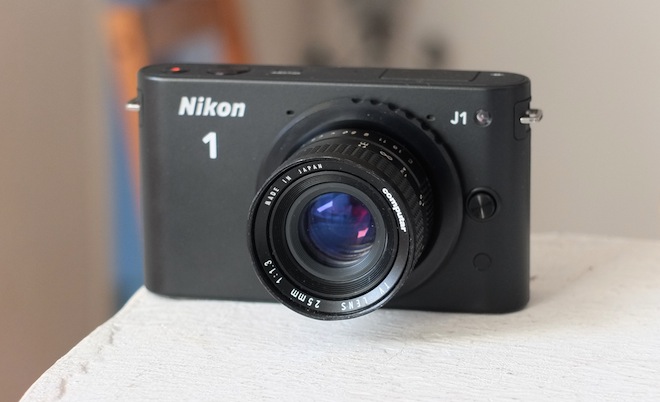
I’ve been shooting with the Nikon J1 recently, using it like a digital 16mm Bolex. Since the sensor is a 2.7x crop, that is much closer to 16mm than the GH2 so more c-mount lenses can be used without vignetting, and it can go to a relatively clean ISO 1600 which you cannot do in Ex Tele crop mode on the GH2 without significant noise.
It certainly isn’t as good a camera as the GH2, NEX 7 or 5D Mark II but it has a unique purpose as a b-camera, artistic shot getter and as something very easy to focus with at fast apertures in low light.
I’ll have some footage online soon. The output is actually very nice but is somewhat hampered by a minimum shutter speed of 1/100 when shooting in PAL regions and the lack of a cinema 24p mode.
In the interview Nikon say they are also going to introduce some faster CX lenses. They don’t need to bother, you can adapt far better stuff already. I’m using some fast F1.3 c-mount lenses and a Kern Switar 10mm F1.9 which is roughly 27mm wide angle on the Nikon J1.

Saturday, 11 February 2012

Nikon unveils the D800, with full-frame 36MP sensor

Nikon has announced the Nikon D800, due this March for roughly $3,000. Also a full frame camera, the Nikon D800 is a more compact version of the D4. But while the D4 had a 16MP CMOS image sensor, the D800 has a 36MP sensor, with a D4 feature set updated to compete against the Canon 5D Mark II. The 12MP Nikon D700 will still be available in most markets.
While the Nikon D800 does not have the Nikon D4’s vertical grip and Ethernet connectivity, it has the same 51-point autofocus system with 15 cross-type sensors, 3.2-inch 921k dot LCD display, support for minimum -2 EV exposure and larger than f/8 maximum aperture lenses, RGB Matrix III meter (91,000 pixel), support for dual-memory card slots (CF and SDXC), support for H.264 B-Frame formats at 1080p30 / 1080p24 / 720p60 / 720p50 resolution, and sensitivity range of ISO 100 through 6400 (boosted to 25,600).
The D800 dSLR can deliver uncompressed HDMI video output, and has the first USB 3.0 port on a Nikon camera. It also features a new headphone jack. 
Nikon will also be releasing the Nikon D800E in April for $3,300, without a low-pass antialiasing filter, which while making the sensor vulnerable to moiré patterns, will provide sharper images at the full 36.3 megapixels. Both cameras are compatible with Nikon F-mount FX and DX lenses, with the DX mode providing a 15.4MP crop section and 5 frames per second, and the FX mode delivering 4 frames per second.

Friday, 10 February 2012

Nikon Corporation is a leading terms of compatible cameras and lenses from different decades. Most lenses compatible with the oldest of the old-fashioned camera to work to many original digital cameras. notion of key letters soup Nikon. Whenever a original feature targets tend to withhold the characteristics of the lens, so the latest a long list of letters tedious the lens. Usually you can ignore the last letter, it is detached excellent. As we will discover more today AF and AI-S and F of the mountain, but not always ready.
 
Nikon 28-300mm zoom lens with ED glass, 10.7 General, the second VR image stabilization. Nikon zoom offers a wide range of focal length for the object to depart, landscapes, portraits and distant. In addition, the Nikon 28 300 Customs AF-S VR lens edge to edge sharpness are affected and DX format digital SLR camera’s DX format digital SLR the focal point of the equivalent 42-450mm optimized FX / 35 mm format.

If you do not mind the size, this considerable 28 300 Nikkor is perfect. I like to fade with him, and Nikon 28-300mm is an ideal employ of a dedicated depart photos. (For the line, Canon S95 in my pocket I have my hold style, rather than foreign exchange SLR around my neck.) Installation manual focus at any time to any person on the focus ring with your fingers. Macro-region, whether voluntary or terminate to terminate, there is no macro turnout residence, because there is a 28–105 automatically Jiaosan Wei. Appropriate scale is very hard, so it is not progress. I can not view can not glance the lock switch, an increase of 28 mm.

Nikon 28 300 lickety-split switching between autofocus and manual switch and the M / focus mode. Although the Internal Focusing (IF) for this lens quick, smooth auto focusing without changing the length, to provide impartial, that the whole focus of the work scope.
Nikon shipshape Integrated Coating to improve the efficiency of light transmission and color provides consistency and to slice stray light. 28 300 Nikon zoom lens the minimum focus lock expansion, to prevent the transport process. Nikon 20-300 is concentrated in the 18 cm to increase the versatility of any focal length.